
Periodic Table Print
Print a clear, full-page periodic table of all 118 elements, colour-coded by element family or in printer-friendly black and white. Choose whether to show names and atomic weights, pick Letter, A4 or tabloid paper, and print or save it as a PDF.
- Free to use
- No sign-up
- Runs in your browser
Print a periodic table
Periodic Table Study Pack
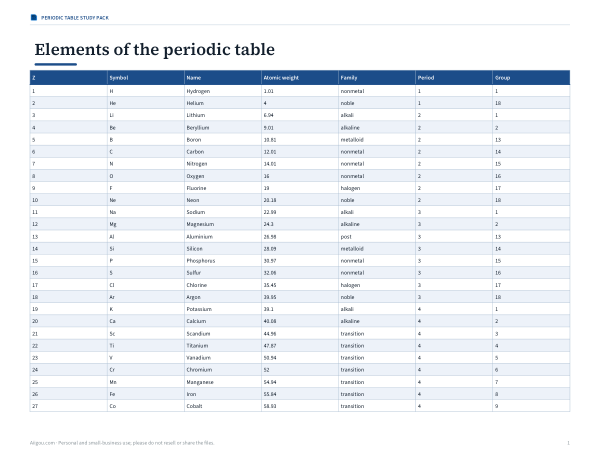
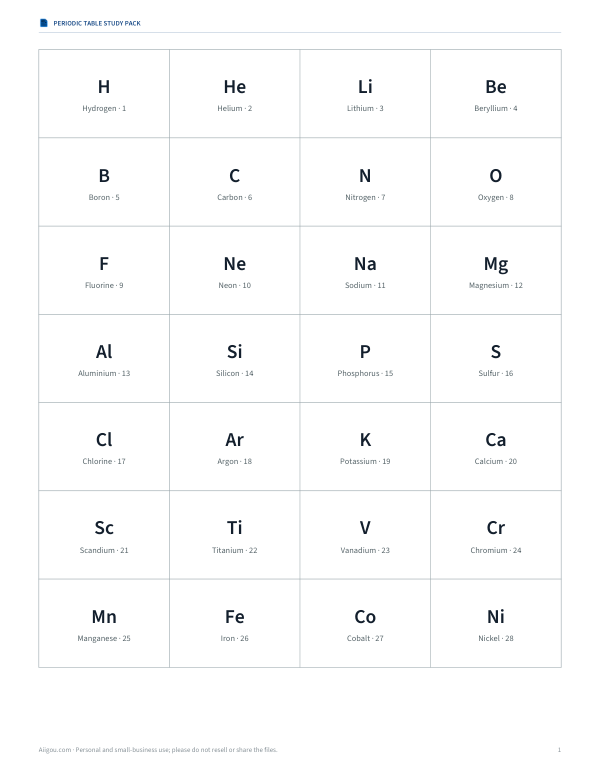
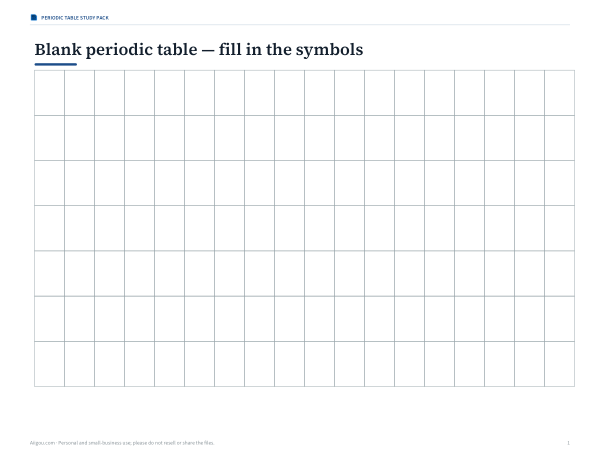
A spreadsheet of all 118 elements with properties to sort and filter, element flash cards, and blank periodic tables for quizzes.
- All 118 elements workbook (XLSX, PDF)
- Element flash cards (PDF, DOCX)
- Blank table for quizzes (PDF, DOCX)
Formats: XLSX, PDF, DOCX. Instant download after payment (link valid 72 hours, up to 5 downloads). AI-assisted: the templates were drafted with AI help and reviewed and laid out before publishing.
$4.00 USD, one-time 3 files · about $1.33 each
- Instant download
- 7-day refund
- Secure checkout by Stripe
7-day money-back guarantee. Full refund within 7 days of purchase, even after you download.
Full refund within 7 days — see the refund policy and license.
Free printables
Single sheets you can print right now, no sign-up. The full pack adds every sheet in one download plus the editable files.
How to print the periodic table
Pick colour or black and white, whether to show element names and atomic weights, and your paper size, then press Print. The table is drawn as a vector graphic sized exactly to the page in landscape orientation, so text stays sharp at any size. In the print dialog, choose landscape, set margins to “None” or “Minimum” and scaling to 100%. For a wall chart, tabloid (11 × 17 inches) paper gives large, readable squares; many copy shops print tabloid or larger. Choose “Save as PDF” to keep a copy or send it to a print shop.
How the periodic table is organised
Elements are arranged in order of increasing atomic number — the number of protons in the nucleus. Rows are called periods: each period corresponds to a new electron shell, which is why the table has seven periods. Columns are called groups, numbered 1 to 18. Elements in the same group have the same number of electrons in their outer shell and therefore similar chemical behaviour: the alkali metals in group 1 all react vigorously with water, and the noble gases in group 18 are very unreactive.
The two rows printed below the main table are the lanthanides (atomic numbers 57–71) and actinides (89–103). They belong in periods 6 and 7 but are shown separately so the table fits on a page; the placeholders in group 3 show where they fit.
What each square shows
| Position | Information |
|---|---|
| Top left | Atomic number — protons in the nucleus |
| Centre | Chemical symbol |
| Below symbol | Element name |
| Bottom | Standard atomic weight (average mass of the naturally occurring isotopes, in unified atomic mass units) |
Some atomic weights are shown in parentheses, such as technetium (98). These elements have no stable isotopes and no characteristic natural isotopic composition, so the number shown is the mass number of their longest-lived known isotope rather than an averaged weight.
The colour families
Colours group elements with related properties: alkali metals, alkaline earth metals, transition metals, post-transition metals, metalloids, reactive nonmetals, halogens, noble gases, lanthanides and actinides, plus a group for the heaviest synthetic elements whose chemical properties are not yet well established. Classification schemes differ slightly between textbooks — for example, whether hydrogen, zinc or the halogens get their own colour — so do not worry if your class chart is not identical. The black-and-white version saves ink and is useful for colouring activities where students shade the families themselves.
Using a printed table in class and at home
- Keep a copy inside a chemistry binder for homework and tests where reference tables are allowed.
- Laminate it and use a dry-erase marker to practise identifying metals, nonmetals and metalloids.
- Print the version without names for self-testing: look at a symbol and recall the name.
- Use the search box to highlight an element before printing, for a worksheet about one element.
- Stick a large tabloid print on the wall of a study space for quick look-ups.
Worked example: finding molar mass
The atomic weights on the table are what you use to calculate molar mass. For water, H₂O, add two hydrogen atoms (2 × 1.008) and one oxygen atom (15.999): 18.015 grams per mole. For table salt, NaCl: 22.990 + 35.45 = 58.44 g/mol. For carbon dioxide, CO₂: 12.011 + 2 × 15.999 = 44.009 g/mol. Many exams provide a printed table like this one, so being comfortable reading it saves time.
About the data
Atomic weights follow the IUPAC standard atomic weights, abridged to four or five significant figures, which is the precision used in most school and general chemistry courses. Some elements, such as lithium, carbon and chlorine, have atomic weights that vary slightly in nature; the table shows the conventional single values commonly used in textbooks. Element names follow IUPAC spelling, including aluminium and caesium; in the US these are usually spelled aluminum and cesium. The four newest elements — nihonium, moscovium, tennessine and oganesson — were officially named in 2016, completing period 7.
A short history of the table
Dmitri Mendeleev published his periodic table in 1869, arranging the known elements by atomic weight and chemical properties and leaving gaps for elements he predicted would be discovered — gallium, scandium and germanium were found within about two decades, matching his predictions closely. In 1913 Henry Moseley showed that atomic number, not atomic weight, is the true ordering principle, which fixed a few pairs that had seemed out of order, such as tellurium and iodine. The modern long form with 18 groups became standard in the twentieth century as the lanthanides and actinides were understood.
Frequently asked questions
How many elements are on the periodic table?
118 confirmed elements, from hydrogen (1) to oganesson (118).
Why are two rows separated at the bottom?
The lanthanides and actinides are placed below the main table so it fits on a page; they belong in periods 6 and 7.
Is the periodic table free to print?
Yes, print as many copies as you like for school, home or work.
What paper size is best?
US Letter or A4 works for binders; tabloid (11 × 17 in) is better for wall charts.
Why do some masses have parentheses?
Those elements have no stable isotopes; the number is the mass number of the longest-lived isotope.
Does it show electron configurations or charges?
This version shows atomic number, symbol, name and atomic weight. Charges and configurations need a larger layout.
Can I print it in colour on a black-and-white printer?
Choose the black-and-white style for the clearest result; colour families print as similar greys otherwise.
Why is hydrogen above the alkali metals?
It has one outer electron like group 1, but it is a nonmetal; many tables place it in group 1 by convention while colouring it differently.